Toddlers: 24 Months+

Time out technique--question

over the weekend dd threw a fit.  i gave her a warning, she continued with the bad behavior, so i put her in timeout for 2 mins.  she sat there and did her 'time'.  when it was over, i went to her told her what she did wrong and asked her to say 'sorry' and give me a hug.  she told me no!  she refused to say sorry, so i told her to say 'sorry' or she would be in timeout for another 2 mins.  didn't make a difference.  this went on for a while, with her refusing to say sorry.  eventually i gave up and settled for a hug.  it just bothers me because she knows to say sorry and just won't! it's a battle with her.  

my question is, do they have to say sorry in order to acknowledge and apologize for their naughty behavior?  if they don't apologize, what do you do???  i want to be prepared for next time.  thank you!!!

image
PLC 7.16.07 * MDC 10.16.10
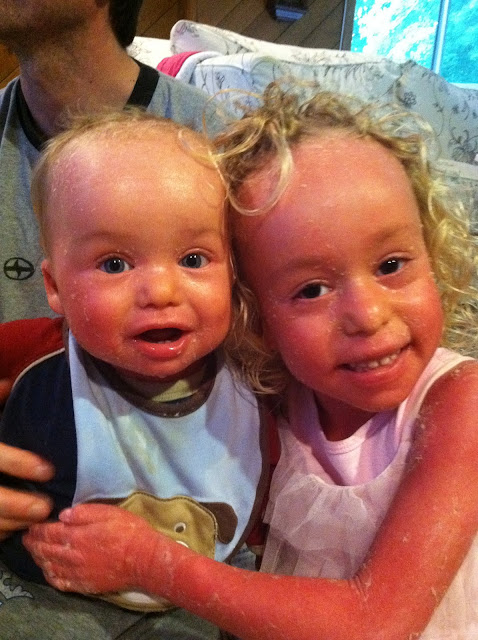
Foundation for Ichthyosis and Related Skin Types
Educate, inspire and connect those touched by ichthyosis and related disorders through emotional support, information, advocacy and research funding for better treatments and eventual cures.

Re: Time out technique--question

  • imo, timeout is really for dc to chill and have some alone time and regroup, so as long as she acknowledges you in some way (the hug) i would let it go and not worry about her saying "sorry"

  • Loading the player...
  • We do 1-2-3 Magic and there is no discussion/apology at the end of a timeout. Especially for a tantrum, I feel like that is natural behavior for a toddler. He gets a timeout to go in hsi room and calm down/get control of himself. He doesn't need to apologize. We actually don't even call it a timeout for tantrums, we just tell him to go to his room, get bear (his security object) and come out when he is calm. It works really, really well for us.  

    The ONLY thing we make him apologize for is physical violence - if he hits someone, etc. That is also one of the only things he gets an official "timeout" for. Everything else we do natural consequences.


    Warning No formatter is installed for the format bbhtml
  • Our daycare teachers recommended not requiring toddlers to say their sorry because they don't really understand the emotional implications.  We just calmly remind DD what she did wrong and ask if she is ready to act nicely/return to dinner/speak nicely, etc. 

    IMO, having a battle of wills to get DC to repeat a phrase isn't worth it.  It is better to phrase a question in a way that they understand and allow them to phrase their own response.

    Heather Margaret --- Feb '07 and Todd Eldon --- April '09
    image
  • imageabpdjs:

    imo, timeout is really for dc to chill and have some alone time and regroup, so as long as she acknowledges you in some way (the hug) i would let it go and not worry about her saying "sorry"

    This. I agree with everyone else as well, including the comment about the preschool teachers saying that toddlers aren't going to understand the actual concept of sorry. DD is 2 1/2 and has just started saying "sorry" when she accidentally bumps into me or if she she me hurt myself, like stubbing a toe or something. She started doing it totally on her own, which I think is really sweet. But if it's after she's been naughty or had a tantrum, I tell her I'm proud of her for cooling off and give her a hug. Our pedi is the one who told me to say that I'm proud after she calms down. 

    Warning No formatter is installed for the format bbhtml
  • I rarely post on here, but I recently had a similar question on another board, that I thought may help you.  I loved this response from another mama: 

    I bookmarked this article a while back and really like it:

    Child experts agree that kids shouldn't be forced to say "sorry" when they do something wrong. However, that doesn't mean kids should be off the hook either. Adults should take the opportunity to teach kids about why the behavior was wrong and about good manners at the same time. Forcing a young child to say sorry after he bites or hits another child, for example, simply forces a lame, insincere "sorry" statement without changing any behavior. So, what should parents and providers do?

    • Use the bad behavior as a teaching moment with the child. Experts have many different opinions, but in general agree that getting the child to think about what he has done wrong, why it was wrong, and the impact the behavior had on the other child is the best way to approach the situation. After giving the child time to think about it, then ask what he can do about it to make the wrong right. And, if the child simply suggests saying sorry or giving a hug, well, then it was his idea and it will certainly be more heartfelt!

    • Label the behavior as wrong. Parents and providers would perform an injustice if they don't simply and plainly spell out that the behavior was wrong. If not, you've reinforced to the child that bad behavior doesn't really matter and won't necessarily have any consequences.

    • Talk about feelings ... alot! By preschool age, kids are beginning to learn about empathy, and feelings often run strong. When a kid learns that his actions caused another child to feel sad or mad, for example, it can have a greater impact than just "getting in trouble." Adults' role should be to help a child to understand, first, that his actions caused another child to get hurt (either physically or emotionally), and then, begin the process of having a child accept responsibility and feel accountable for his own actions.

    • Child care providers and partners should partner on teaching the reason behind "sorry." Good communication is a way to help a child on the path to understanding the reason behind feeling the way he does, and of being sorry. Talk about an approach so consistency is applied whether a child is at home with a parent or in the care of a provider. Consistent discipline and discussion lets a child better understand that there are rules and when broken, there are consistent consequences.

    • Be sure to show love at the same time. Never let a child feel unloved for doing something wrong. Remember the old adage of, "I love you; just not your behavior!"
  • If your child is talking well, rather than telling her what she did to get the time out, ask her to tell you why she was put in time out.  We try not to say "waht did you wrong?" but use phases such as what behavior did you use that was not OK or stuff like that.  My girls know they have to sorry since they do it at daycare as well.  We do the same thing where if they do not tell us why they ended up in time-up and say sorry, they stay there longer.  We always talk about the behavior that got them in time out and ways that can they do it differently next time.  It always ends with an I'm sorry, a hug and a kiss and I love you.  If they are not ready to do that then are not ready to be out of time out.  We tell my older to go out her head down until she calms down and then come talk about it when she is ready.  Younger DD is still to young and not enough words for a lot of this yet but we do a revised thing and it seems to work.  Older DD sometimes has a tantrum that we ignore and then is ready to come talk.
    Jenni Mom to DD#1 - 6-16-06 DD#2 - 3-13-08 
This discussion has been closed.
Choose Another Board
Search Boards
"
"